page_banner

Blog

China Best Fleece And Sherpa Jacket Manufacturer?

Choosing the best Fleece And Sherpa Jacket manufacturer in China requires more than comparing prices. Buyers should examine production experience, material control, workmanship, and communication. A reliable factory understands how fleece weight affects warmth, breathability, and drying speed. It also knows how sherpa lining changes fit and comfort.

Look closely at the details. Check fabric samples under natural light. Feel the pile, inspect seam density, and test zipper movement repeatedly. Experienced manufacturers can explain fabric composition, shrinkage control, colorfastness testing, and seasonal capacity. They should also provide clear size charts and practical sample approval procedures. Certifications and audit reports matter, but verifiable records matter more than attractive claims.

Quality inspection should continue from knitting to packing. Ask how the factory checks loose threads, uneven stitching, pilling, and measurement tolerances. Small defects become expensive after bulk production. They also damage customer trust. Custom labels, recycled fabrics, private packaging, and flexible order quantities can improve commercial value. Yet customization needs realistic timelines.

No manufacturer is perfect. That deserves honest attention. A factory may offer strong sewing skills but limited design support. Another may provide excellent samples but struggle during peak seasons. Buyers should compare evidence, not promises. Factory visits, live video inspections, third-party testing, and written specifications create stronger confidence. The right Fleece And Sherpa Jacket partner combines proven experience with transparent communication. It should also acknowledge problems early and correct them professionally. That is often more valuable than claiming to be the cheapest or simply the best.
China Best Fleece And Sherpa Jacket Manufacturer?

What Defines a Leading Fleece and Sherpa Jacket Manufacturer in China

What Defines a Leading Fleece and Sherpa Jacket Manufacturer in China

A leading Chinese fleece and sherpa jacket manufacturer combines material knowledge with disciplined production control. Textile Exchange’s Materials Market Report 2024 recorded global fiber production at about 124 million tonnes in 2023. Polyester represented roughly 57% of that volume. This scale makes recycled content, fiber origin, and shedding control important purchasing questions. A capable factory should provide material certificates, fabric weight records, and laboratory test results. Not just attractive samples.

Practical experience appears in the details. Technicians check pile height, brushing consistency, seam strength, colorfastness, and pilling performance. They also test zippers, elastic bindings, and pocket reinforcement after repeated washing. A 280–320 gsm sherpa fabric may feel warm, yet excessive bulk can restrict movement. Fit testing must happen on real bodies, not only mannequins. Small details decide.

Reliable manufacturers maintain documented inspections from knitting to packing. They should explain sampling plans, acceptable defect limits, production capacity, and corrective actions. Independent factory assessments can strengthen credibility, but paperwork cannot replace production evidence. Not every sample survives production. That is a useful warning. Buyers should compare pre-production samples with bulk garments and request shipment records when possible. Energy use, wastewater management, and worker safety also deserve verification, especially as supply-chain transparency expectations continue rising. The best partner is not always the cheapest one; sometimes it is the factory that admits a process weakness and fixes it before delivery.

Key Materials and Construction Standards for Fleece and Sherpa Jackets

China Best Fleece And Sherpa Jacket Manufacturer?

Material selection controls warmth, weight, and service life. Textile Exchange’s Materials Market Report 2024 reports that polyester made up about 59% of global fiber production in 2023. This explains its popularity in fleece and sherpa jackets. However, fiber content alone proves little. Fleece needs stable knitting, even brushing, and controlled pilling. Sherpa requires dense pile, secure backing, and clean seam joining. A loose pile may shed after several washes.

Construction standards should be measurable. Test fabric abrasion under ASTM D4966 and tensile strength under ASTM D5034. Use ISO 6330 laundering procedures to check shrinkage, color change, and surface damage. For recycled polyester, request traceable documentation, such as a valid recycled-content certificate. A practical jacket inspection should also examine zipper alignment, bartack strength, pocket corners, and seam allowance. Small details matter. I have seen attractive samples fail after repeated washing because the cuffs stretched too quickly.

Tips: Compare samples after five to ten wash cycles, not only when new. Record fabric weight, pile height, shrinkage, and pilling grade. Textile Exchange data supports lower-impact material planning, but recycled fibers still need strong construction. Do not treat a certificate as a quality guarantee. Test the finished jacket. This step is often skipped.

China Best Fleece And Sherpa Jacket Manufacturer? - Key Materials and Construction Standards for Fleece and Sherpa Jackets

Evaluation Dimension Recommended Material or Specification Typical Technical Data Construction and Quality Requirements Relevant Test Method or Reference
Outer Fleece Fabric Polyester fleece, commonly made from recycled or virgin polyester yarns Fabric weight: approximately 180–350 g/m²; common structures include single-sided and double-sided fleece Surface should be evenly brushed, with consistent pile height, limited pilling, and no visible streaks, holes, or needle damage ASTM D3776 or ISO 3801 for fabric mass per unit area; ASTM D3512 or ISO 12945-1 for pilling assessment
Sherpa Fleece High-pile polyester sherpa with a dense, wool-like pile Fabric weight: approximately 250–450 g/m²; pile height commonly around 8–18 mm Pile should be dense and resilient, with secure fiber anchoring, even color, and minimal shedding after brushing and laundering ISO 3801 for fabric weight; ISO 12945-2 for pilling; internal shedding and wash-retention testing is recommended
Lining Material Polyester taffeta, mesh, jersey, or lightweight brushed tricot Typical weight: approximately 60–120 g/m², selected according to warmth, mobility, and garment structure Lining should be compatible with the shell fabric, smooth against the skin, and securely attached at armholes, hem, collar, and zipper areas ISO 3801 for fabric weight; dimensional-change testing after laundering should be specified by the buyer
Thermal Insulation Fleece or sherpa pile used as the primary insulation; optional polyester wadding for colder conditions Optional wadding weight: approximately 40–120 g/m² depending on the target climate and jacket category Insulation must be evenly distributed without cold spots, excessive bulk, fiber migration, or bunching at seams Thermal performance may be assessed using ASTM F1868 or ISO 11092, depending on the test configuration
Fabric Strength Woven reinforcements may be added to high-stress areas such as elbows, pocket openings, and shoulders Target performance depends on fabric weight and end use; reinforced areas should exceed the base fabric in abrasion and tear resistance Seams and panels should not split during normal wear, stretching, or repeated dressing; bartacks are recommended at pocket corners ASTM D5034 or ISO 13934-1 for tensile strength; ASTM D1424 or ISO 13937-1 for tear strength
Abrasion Resistance Dense fleece construction and durable face finishing for frequent outdoor or workwear use Performance should be validated against the intended wear level rather than a single universal pass/fail value After testing, the fabric should not show unacceptable holes, severe matting, excessive pilling, or major loss of appearance ASTM D3884 or ISO 12947 Martindale abrasion testing
Pilling Control Low-pilling polyester yarns, optimized brushing, heat setting, and anti-pilling finishing where appropriate Commercial products commonly specify a minimum visual rating of 3–4 after the agreed number of cycles Acceptance criteria should be confirmed using the buyer’s color, fabric weight, laundering method, and visual grading standard ISO 12945-1, ISO 12945-2, or ASTM D3512; the selected method should remain consistent during development
Dimensional Stability Pre-set or heat-stabilized fleece and sherpa fabric Typical commercial target: shrinkage within approximately ±3% after the agreed care cycle Pattern allowances, seam matching, and zipper length must account for any expected fabric shrinkage or relaxation ISO 6330 for domestic washing and drying procedures; ISO 5077 for dimensional-change measurement
Colorfastness Disperse-dyed polyester with shade approval completed before bulk production Common target ratings: grade 4 or higher for washing and rubbing; lightfastness requirements vary by end use Dark and bright colors require special attention to crocking, cross-staining, shade variation, and batch-to-batch consistency ISO 105-C06 for washing; ISO 105-X12 for rubbing; ISO 105-B02 for artificial light exposure
Seam Construction Lockstitch or overlock seams with polyester sewing thread; flatlock seams for reduced bulk where needed Typical seam density: approximately 10–14 stitches per inch, adjusted for fabric thickness and seam type Seams should be straight, secure, and free from skipped stitches, loose thread tails, seam puckering, and raw-edge exposure ASTM D1683 or ISO 13935 series may be used for seam-strength evaluation; factory workmanship standards should define visual tolerances
Zippers and Closures Coil or molded-tooth zipper with corrosion-resistant puller and suitable slider strength Main zipper size is selected according to jacket weight and use; pocket zippers may use a lighter specification Zipper tape must be securely stitched, aligned, smooth-running, and protected from direct skin contact where comfort is important Zipper specifications should include opening and closing cycles, slider performance, dimensional checks, and visual inspection
Pocket and Stress-Point Reinforcement Self-fabric, woven binding, bartacks, or reinforcement patches Reinforcement size and stitch density should be adapted to pocket opening length and expected load Pocket corners, drawcord exits, cuff attachments, and shoulder seams require secure stitching and adequate seam allowance AQL inspection should include pocket attachment, bartack security, stitch integrity, and functional load checks
Cuffs and Hem Finish Elastic binding, stretch fleece, rib knit, or adjustable hem construction Elastic recovery and cuff opening should be measured against the approved size specification Cuffs should retain shape after repeated stretching; hems should be even, covered, and free from tunneling or twisting Dimensional checks after laundering and repeated stretch testing are recommended for production approval
Water-Repellent Option Durable water-repellent finish on the outer face or a wind-resistant woven overlay Water-repellency performance depends on fabric construction, finish chemistry, and laundering conditions The finish should not cause unacceptable stiffness, odor, color change, or loss of breathability; claims should be supported by test data AATCC TM22 or ISO 4920 for spray rating; hydrostatic or rain tests may be added for water-resistant designs
Breathability Open fleece construction, mesh panels, or moisture-managing lining where increased ventilation is required Breathability targets should be set according to the intended activity level and garment layering system Ventilation features must not weaken seams or expose insulation; fabric selection should balance warmth, air permeability, and comfort ISO 9237 for air permeability; ISO 11092 for water-vapor resistance
Chemical and Product Safety Restricted-substance-compliant dyes, trims, coatings, and auxiliaries Requirements depend on the destination market and the buyer’s restricted-substance list Bulk materials, accessories, prints, and packaging should be traceable to approved suppliers and tested when required Applicable frameworks may include REACH requirements, OEKO-TEX Standard 100, CPSIA, or the buyer’s own RSL
Finished Garment Inspection Final inspection based on approved sample, measurement chart, workmanship manual, and packing specification Common quality systems use AQL sampling; the exact inspection level and defect limits must be agreed before production Inspection should cover measurements, appearance, shade, zipper function, seam security, labeling, odor, loose fibers, and packaging ISO 2859-1 or ANSI/ASQ Z1.4 may be used for sampling plans; critical defects should be separately defined

Note: Technical targets are typical commercial reference ranges. Final specifications should be confirmed through an approved sample, destination-market requirements, care-label instructions, and a signed quality standard.

Manufacturing Capabilities and Customization Options

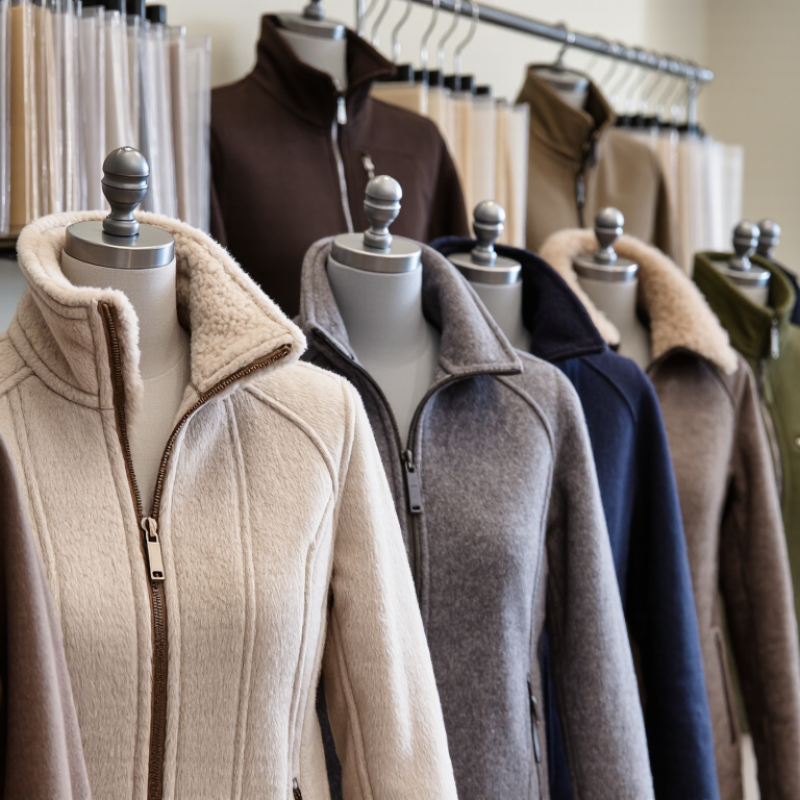
A capable China fleece and sherpa jacket manufacturer should offer more than standard production. It needs practical control over fabric, fit, construction, and delivery. Experienced teams can work with different fleece weights, sherpa textures, recycled polyester blends, and brushed finishes. Fabric samples should be checked for softness, pilling, color consistency, and shrinkage before bulk production. Details matter.

Customization may include jacket length, collar shape, hood design, pocket placement, cuffs, zippers, lining, labels, and packaging. Pattern makers can adjust measurements for different markets and body types. Buyers may also request graded size sets, custom colors, embroidery, or printed artwork. Fit comes first. A clear tech pack reduces confusion, but it cannot replace physical samples.

Reliable manufacturers normally use pre-production samples and in-line inspections. They should record fabric composition, weight, measurement tolerance, and testing results. Quality checks can cover seam strength, zipper function, needle control, and appearance after washing. Not every first sample is right. Sleeve balance may need revision, or sherpa thickness may affect the armhole. That takes testing. Open communication helps solve these issues before shipment. Production capacity should also be discussed honestly, including minimum order quantities, sample timing, peak-season limits, and corrective procedures. A supplier that explains weaknesses clearly is often more dependable than one promising everything.

Quality Control, Certifications, and Production Compliance

China’s best fleece and sherpa jacket manufacturer should prove quality through controlled production, not attractive samples alone. Textile Exchange’s Materials Market Report 2024 recorded global fiber production at 132 million tonnes in 2023. Polyester represented about 57% of that volume. This makes fiber traceability and recycled-content verification important purchasing checks.

A reliable factory should operate documented procedures aligned with ISO 9001 principles. Inspectors should check fabric weight, pile height, colorfastness, seam strength, zipper performance, and garment measurements. For sherpa jackets, uneven pile or loose fibers can appear after washing. Pre-production testing must include shrinkage and abrasion checks. Random final inspections should follow an agreed sampling standard. Certifications for harmful substances, such as OEKO-TEX Standard 100, can support safer material decisions. However, a certificate is not proof that every shipment is perfect. I have seen strong reports fail when factory records were incomplete.

Tips: Request current certificates, audit dates, test reports, and corrective-action records. Ask for lot-level fabric traceability. Verify recycled claims through transaction documents. Check whether workers receive safety training and whether production follows written labor and environmental procedures. The International Labour Organization stresses effective workplace safety systems, but paperwork alone cannot replace factory visits. Photograph approved samples, measure finished garments, and retain sealed testing specimens. Small gaps matter. A missed needle check or unapproved trim can create costly rework. Suppliers should welcome independent inspections and explain failures clearly. That honesty is often more valuable than a perfect presentation.

How to Evaluate and Select the Best Chinese Manufacturer

Choosing the best Chinese fleece and sherpa jacket manufacturer requires more than comparing online photos. Start by checking factory experience, production equipment, and documented quality procedures. A reliable supplier should explain fabric composition, weight, brushing method, and shrinkage control clearly.

Request physical samples before discussing large orders. Examine the fleece density, sherpa softness, zipper movement, stitching tension, and seam strength. Ask whether the sample matches regular production materials. Fabric certificates, inspection records, and product testing reports can support professional judgment. However, documents alone are not enough. An on-site or video factory audit can reveal cutting accuracy, worker organization, storage conditions, and production capacity.

Communication is another practical test. The manufacturer should answer technical questions directly and provide a realistic timeline for sampling, production, and inspection. Confirm minimum order quantities, customization limits, packaging details, and corrective-action procedures in writing. Check whether the factory can trace fabric lots and replace defective goods under agreed terms. A low quotation may hide thin fabric, unstable sizing, or weak after-sales support.

Do not trust presentation alone. I have seen attractive samples fail after repeated washing. That experience makes testing essential. Ask for wash tests, colorfastness checks, and measurements across several sizes. Capacity claims may also be exaggerated, so compare stated output with machinery and recent production evidence. The best choice is usually the manufacturer that communicates limitations honestly and improves details when problems appear.

How to Evaluate and Select a Chinese Fleece and Sherpa Jacket Manufacturer

A practical sourcing scorecard focused on the factors that most directly affect product quality, delivery reliability, compliance, and total cost.

Quality control and material consistency receive the highest weighting because fleece and sherpa jackets depend on fabric composition, weight, pile density, shrinkage control, stitching, and colorfastness. Compliance, production capacity, lead time, minimum order quantity, and communication should also be verified through factory audits, product samples, test reports, production records, and written quotations.